Biofuels Explained: What They Are and How They Impact the Environment
This explainer provides an introductory overview of biofuels, their production processes, climate impacts, related fuel policies, and the key economic challenges under discussion in policy debates.
Key Takeaways
- Biofuels are widely used today, particularly in ground transportation, and are beginning to play a role in aviation, where low-carbon alternatives to liquid fuels remain limited.
- Biofuels have the potential to reduce net greenhouse gas emissions relative to petroleum fuels because biofuels recycle carbon that was recently absorbed by biomass. However, their climate benefits depend on feedstock choices and production practices, land use effects, and which fuels biofuels displace.
- US biofuel policy includes a mix of volume mandates, emissions-based standards, and tax credits. These policies shape how much biofuel is produced, which types are produced, and how biofuels are allocated across regions and sectors.
- Estimating the net carbon emissions benefits of biofuels requires lifecycle analysis, which relies on detailed modeling choices, some of which remain the subject of ongoing debate.
- While some biofuels are now widely used in commercial fuel markets, scaling advanced biofuels, which rely on less land-intensive raw materials, remains a key policy challenge.
Introduction
Biofuels are fuels made from biological materials such as crops, waste oils, and agricultural residues. They have the potential to reduce net greenhouse gas emissions relative to petroleum fuels because they recycle carbon that was recently absorbed by biomass. Biofuels receive policy attention due to their potential to address multiple energy and environmental challenges:
- They offer one of the few near-term options to lower greenhouse gas emissions from sectors that are difficult to electrify (for example, aviation, shipping, and long-haul trucking).
- Biofuels are produced from renewable biological sources, which can enhance energy security by reducing reliance on petroleum fuels. This consideration becomes more salient when petroleum prices are volatile or when geopolitical disruptions affect fossil fuel supply.
- Biofuels can support rural economies by creating new markets for agricultural and forestry products.
Biofuel production also raises important considerations. Whether and to what extent biofuels reduce greenhouse gas emissions relative to fossil fuels depends on how feedstocks (i.e., raw material inputs) are grown, the emissions associated with processing and transporting the biofuels, and how increased demand for biofuel feedstocks affects land use. The system-level impacts of biofuels also depend on where they are used and which fuels they displace.
Biofuel production also raises other concerns, such as competition with food crops, high water use in some feedstock production, and impacts on biodiversity. This explainer provides an overview of the major biofuels used for transportation in the United States and describes the policy frameworks and some of the key debates that shape their use.
Types of Biofuels
Most biofuels consumed in the United States today are used in ground transportation, with aviation representing a much smaller, but growing, use. Some of the key fuels that are already in commercial use are as follows:
- Ethanol, the most widely used biofuel, is generally produced from starch and sugar crops, such as corn and sugarcane. It is blended into nearly all gasoline sold nationwide, typically at 10 percent by volume (E10). Higher blends, such as E15, are compatible with most gasoline vehicles sold today, though most gasoline is still sold as E10.
- Biodiesel is made from fats and oils, such as vegetable oils, animal fats, and recycled cooking oil. It is blended with petroleum diesel, commonly at levels such as 5 percent by volume (B5) or 20 percent by volume (B20). These blends can be used in most modern diesel engines without engine modification. Some newer engines are designed to handle higher blends.
- Renewable diesel, like biodiesel, is produced from fats and oils. Unlike biodiesel, it is chemically indistinguishable from petroleum diesel and can fully replace diesel fuel in existing engines and fuel systems. Its use has grown rapidly in recent years, driven in part by low-carbon fuel policies such as California’s Low Carbon Fuel Standard.
- Sustainable aviation fuel (SAF) refers to alternatives to conventional jet fuel that can be produced from feedstocks such as oils and fats, alcohols, and other forms of biomass using different production pathways (see Table 1). When blended with conventional jet fuel, SAF can be used in existing aircraft and fueling systems without modification. However, production remains limited by high costs and competition for feedstock supply.
Figure 1. Production of Selected Biofuels in the United States Over Time
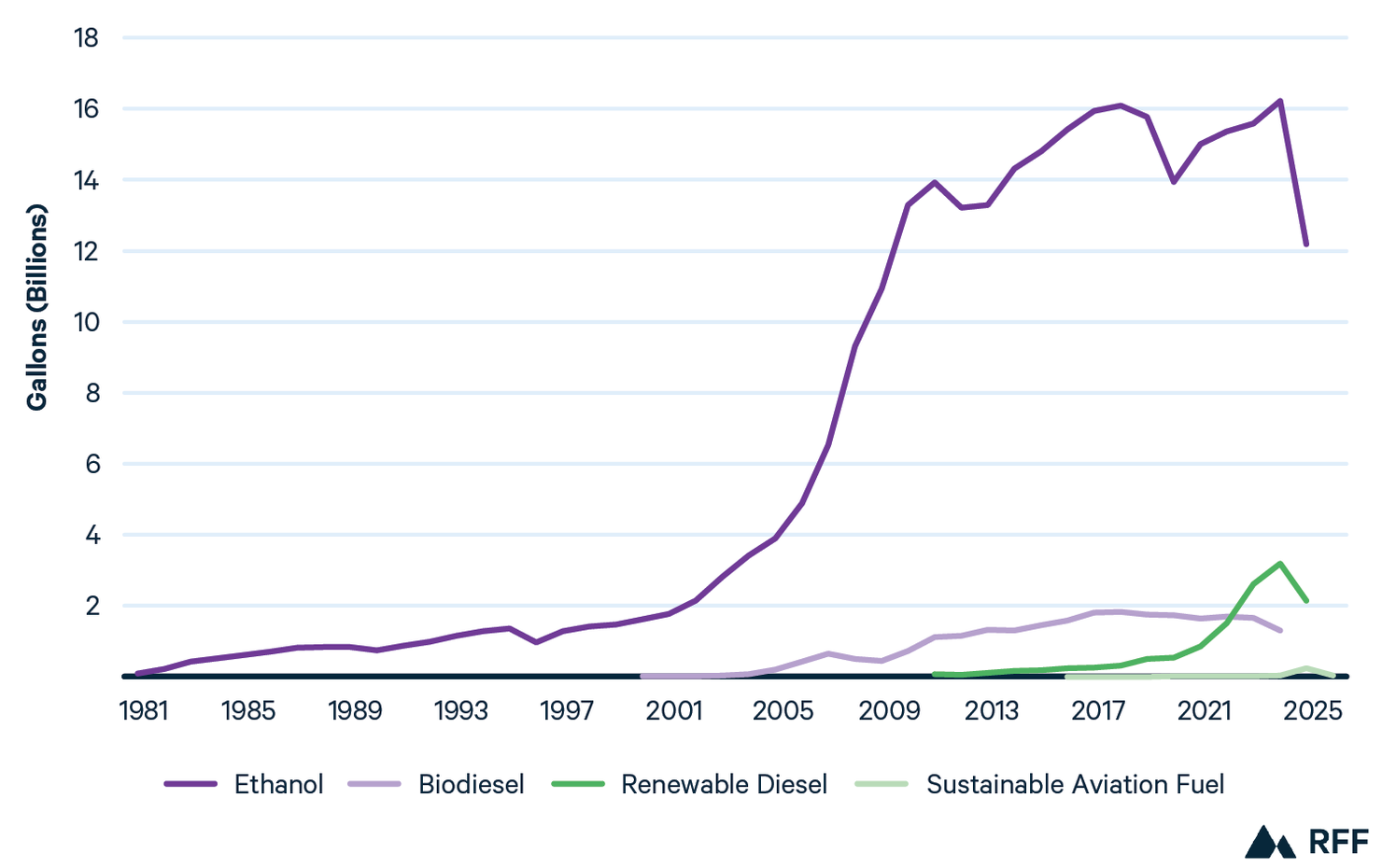
Note: Ethanol, renewable diesel, and biodiesel volumes are from US Department of Agriculture (USDA) production data. Sustainable aviation fuel volumes (not reported in USDA data) are based on US Environmental Protection Agency (EPA) data on fuel used for compliance under the Renewable Fuel Standard and include imports. These EPA data are not directly comparable with the USDA figures (which reflect domestic production), but they provide a rough sense of the scale of deployment.
Sources: USDA US Bioenergy Statistics 2026; EPA RINs Generated Transactions (2026).
Biofuel Production
Feedstocks and Production Processes
The various types of biofuels described above can be produced from a wide range of feedstocks and production processes. The table below describes the feedstocks and production processes used to make different biofuels.
In the United States, most ethanol is produced from corn, while most biodiesel and renewable diesel is produced from vegetable oils. Fuels derived from non-food feedstocks such as agricultural residues, woody biomass, and waste oils have seen more limited deployment. In policy discussions, these fuels derived from non-food feedstocks are often referred to as “advanced biofuels,” because they are intended to address some of the concerns associated with crop-based biofuels.
Key Producers of Biofuels
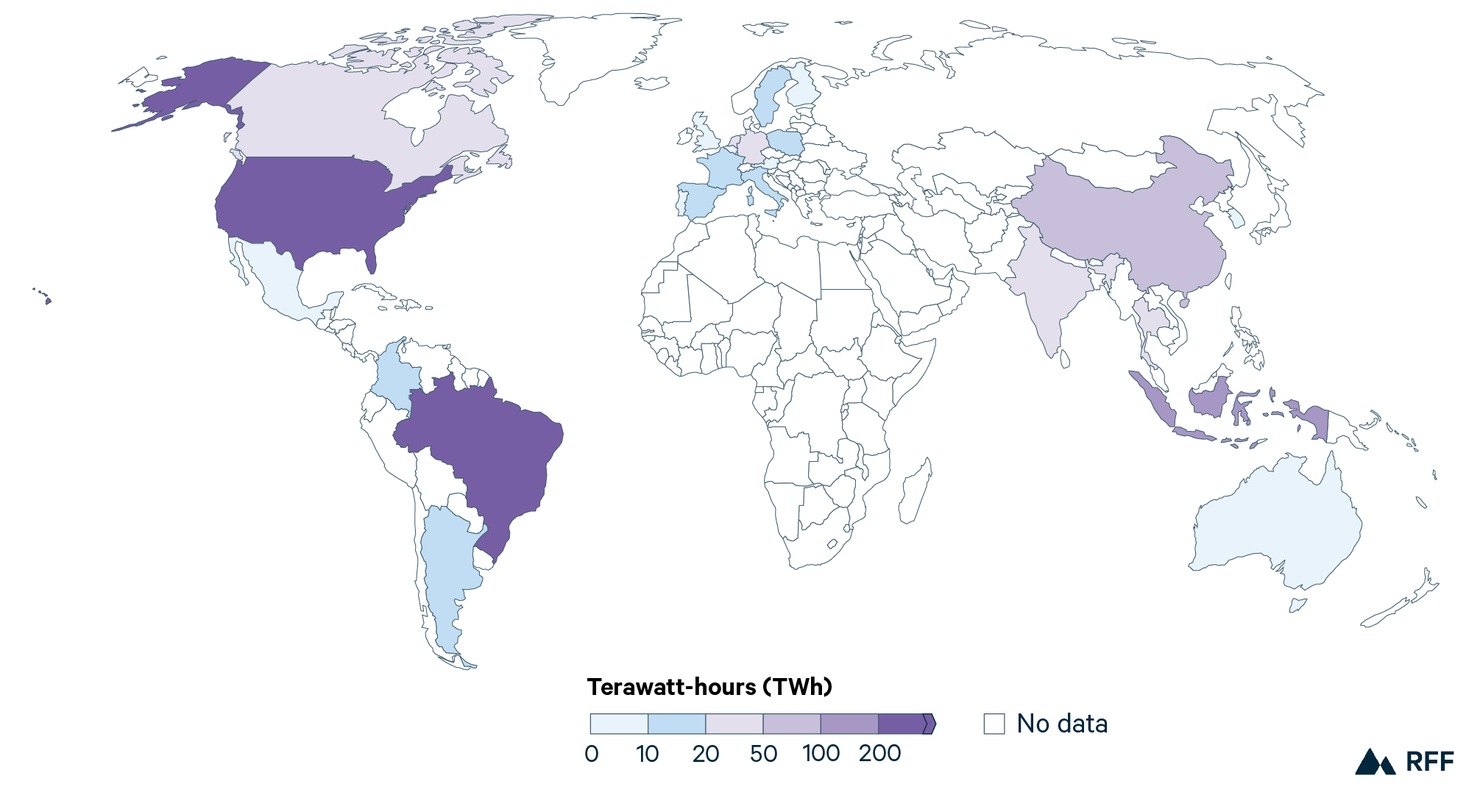
The United States is the world’s largest producer of biofuels and a major exporter. Brazil is the second-largest producer. Both countries have advantages in producing biofuels due to their abilities to produce certain feedstocks locally at scale, their expertise in processing those feedstocks, and supportive government policies. Other notable producers include Asian countries such as Indonesia, China, India, and Thailand, and European countries such as Germany, the Netherlands, France, and Spain, as shown in the figure below.
Figure 2. Country-level Biofuel Production in 2024
Measuring the Climate Impact of Biofuels
Like fossil fuels, biofuels release carbon dioxide emissions during combustion. However, some of these emissions can be partly offset by reductions in greenhouse gas emissions elsewhere in the fuel’s lifecycle. For crop-based feedstocks, plants absorb carbon dioxide from the atmosphere as they grow, which can offset some of the emissions released when the fuel is used. For fuels made from residues or waste materials, using these feedstocks can avoid some greenhouse gas emissions that would occur if the materials were instead left to decompose.
Assessing the emissions performance of biofuels, therefore, requires considering emissions across the full fuel lifecycle rather than from combustion alone. This performance is summarized using a metric known as carbon intensity, which estimates net greenhouse gas emissions per unit of energy. Carbon intensity is estimated using an approach known as lifecycle analysis, which accounts for emissions associated with a fuel’s production, transportation, and use. Several US biofuel policies tie incentives to the carbon intensity of fuels relative to conventional petroleum fuels, with lifecycle emissions estimated using models such as Argonne National Laboratory’s Greenhouse gases, Regulated Emissions, and Energy use in Technologies (GREET) model.
Biofuel Policy in the United States
In the United States, federal and state policies can stimulate biofuel production through volume-based mandates, emissions-based performance standards, and tax credits. These policies differ in design and scope but together shape how biofuels are produced, traded, and used across sectors. Below, we describe major policies shaping the biofuel production landscape in the United States.
Renewable Fuel Standard
Created under the Energy Policy Act of 2005, the Renewable Fuel Standard requires specified volumes of renewable fuels to be blended into petroleum-based transportation fuels. EPA sets annual requirements for renewable fuel volumes across several categories of biofuels, with fuels classified based on lifecycle greenhouse gas emissions.
Compliance is tracked through a system of tradable credits known as Renewable Identification Numbers. Obligated parties—mainly refiners and importers of petroleum fuels—must either blend the required percentage of renewable fuels or purchase Renewable Identification Numbers from other parties that exceed their own obligations. Noncompliance can result in substantial penalties from EPA.
State-level Low Carbon Fuel Standards
Several states regulate transportation fuels based on carbon intensity. California’s Low Carbon Fuel Standard sets a declining carbon intensity target for transportation fuels sold in the state. Similar programs operate in New Mexico, Oregon, and Washington State and are being developed or considered in other states.
Under these programs, regulated fuel suppliers, such as importers and refiners, whose fuels are less carbon intensive than the annual target, generate credits. Those whose fuels are more carbon intensive incur deficits. Although these programs primarily regulate ground transportation fuels, they also allow SAFs to participate on an “opt-in” basis; meaning, SAFs can generate credits when supplied under an approved fuel pathway, even though conventional jet fuel is exempt and does not generate deficits.
45Z Clean Fuel Production Credit
At the federal level, the Clean Fuel Production Credit (Section 45Z of the tax code) provides a tax credit for qualifying low-emissions transportation fuels, including biofuels. This credit is not tied to a specific type of fuel or production technology; instead, eligibility is based on a fuel’s estimated lifecycle carbon intensity.
Originally created under the Inflation Reduction Act of 2022, the credit was later extended under the One Big Beautiful Bill Act of 2025, with changes to eligibility criteria, lifecycle emissions calculations, and the credit value for SAFs.
Key Policy Debates and Economic Challenges
Biofuels have been the subject of several economic and policy debates that continue to shape their roles in the energy system. Some of the most prominent debates concern how emissions are measured, how biofuel production affects land use and food markets, and how policy can support less-mature biofuel technologies.
Carbon Intensity Estimation
Carbon intensity scores estimated through lifecycle analysis play a central role in many biofuel policies. However, estimating carbon intensity scores requires modeling choices and assumptions about emissions across different stages of the fuel supply chain. Differences in modeling assumptions can lead to different estimates of a fuel’s emissions performance. For example, emissions estimates for fuels made from residues or waste materials depend on assumptions about how those materials would otherwise be used or disposed of—outcomes that cannot be directly observed and must be inferred, which can lead to wide variation in estimated carbon intensity scores. Because carbon intensity estimates can affect both eligibility for policy incentives and the value of those incentives, debates over modeling choices and data inputs have become an important part of biofuel policy discussions.
Indirect Land Use Change
First highlighted by Searchinger et al. (2008), indirect land use change is one of the most contested components of lifecycle analysis for biofuels and a central issue in biofuel policy. Indirect land use change refers to the market-mediated expansion of agricultural land that can occur when biofuel production increases demand for agricultural feedstocks. This issue affects carbon intensity estimates, because land conversion can release large amounts of stored carbon and can change whether a biofuel is treated as low-carbon fuel under policy.
When biofuel policies increase demand for crops used as biofuel feedstocks, crop prices may rise. Because global agricultural markets are interconnected, higher crop prices can lead to a market-mediated expansion of farmland elsewhere in the world. If this expansion occurs in forests or grasslands that store large amounts of carbon, the resulting emissions can offset some of the climate benefits of biofuels. Estimating these effects requires economic models of global agricultural markets, and several different models have been used to quantify them. Because these models rely on different, difficult-to-verify assumptions about how markets respond, they can produce widely varying estimates of emissions associated with indirect land use change.
Food Versus Fuel
A concern, particularly relevant to crop-based biofuels, is competition between fuel and food production. Food prices may rise when crops or land that would otherwise be used for food production are diverted to produce biofuel feedstocks. A large empirical literature finds that biofuel policies (e.g., the Renewable Fuel Standard) have increased prices for some crop commodities used as biofuel feedstocks, though estimated effects vary across studies and contexts.
Policy Design and Scaling of Advanced Biofuels
While biofuel production in the United States has expanded under federal and state policies, growth has been uneven across different types of fuels. As noted earlier, fuels based on cellulosic or other non-food feedstocks—which address some of the land use and food market impacts associated with crop-based biofuels—have seen much more limited deployment than crop-based biofuels. This reflects higher costs, long development timelines, uncertainty over future policy incentives, and limited support for early-stage deployment. Moving forward, policymakers will need to consider how existing policy frameworks can better support a coherent transition from early development to large-scale commercial deployment for these advanced biofuels.