The Future of Biofuels: Policy Lessons and Research Directions
This report examines biofuels’ role in the energy transition, key debates in life-cycle assessment and indirect land use change modeling, and lessons from existing federal and state biofuel policies.
Abstract
Overlapping economic, energy security, and environmental rationales have contributed to relatively broad political support for biofuel policy in the United States over time. Biofuels can reduce reliance on imported petroleum, create new markets for agricultural and forestry products, and are often discussed as a potential near-term option for decarbonizing difficult-to-electrify sectors such as aviation, marine shipping, and heavy-duty transport. Expanding biofuel production, however, can impact land and water use, biodiversity, and competition with food crops, and there is ongoing debate about how biofuel production, and the policies that support it, affect greenhouse gas emissions. Drawing on a 2025 Resources for the Future webinar series and a follow-up expert discussion with participants from industry, policy, and academia, this report discusses the potential role of biofuels in the energy transition, provides an overview of key areas of debate in life-cycle assessment and indirect land use change modeling, and highlights lessons from experience with existing federal and state biofuel policies. The report concludes by identifying policy-relevant knowledge gaps and research needs.
1. Introduction
Biofuels are liquid or gaseous fuels derived primarily from biological sources such as crops, waste oils, and agricultural residues. Used mainly in transportation, they are often positioned as a near-term option to lower greenhouse gas (GHG) emissions in sectors that are difficult to electrify, including aviation, shipping, and long-haul trucking. They can also reduce reliance on imported petroleum and create new markets for agricultural and forestry products. These overlapping economic, energy security, and environmental rationales have contributed to relatively broad political support for biofuels in the United States over time. Expanding biofuel production, however, raises broader concerns, such as the impacts on land use, water use, biodiversity, and competition with food crops, making their role in the energy transition a subject of ongoing debate.
Recent federal actions have refocused attention on these issues. While support for many renewable energy sources was cut under the reconciliation bill signed into law summer of 2025 (also known as the One Big Beautiful Bill Act), the Section 45Z Clean Fuel Production Credit (hereafter 45Z) was extended through 2029, with modifications limiting eligible feedstocks to North America, dropping indirect land use accounting, and reducing the value of the credit for sustainable aviation fuel (SAF) starting in 2026. Renewable Fuel Standard (RFS) blending volumes have continued to increase as well, with the US Environmental Protection Agency (EPA) setting higher blending volumes for 2026 and 2027. This continued federal support raises the importance of understanding the long-term role of biofuels in the energy transition, their environmental performance, and the effects of alternative policy choices, which shape not only the scale of biofuel production, but also which types of biofuels expand and where they are ultimately deployed.
Two closely related questions merit attention. First, what methodological challenges arise in life cycle assessment (LCA)—the framework used to account for greenhouse gas emissions along a fuel’s full supply chain—and how should LCA be used in policy? Many current policies use LCA to estimate a single policy-relevant metric, carbon intensity (CI), which is used to determine eligibility and credit levels. Yet jurisdictions employ different modeling frameworks, assumptions, data inputs, and parameter choices, leading to differing emissions estimates. Because policy incentives depend directly on these modeled results, it is important to understand the sources of variation across models, the uncertainties inherent in LCA, and the appropriate role of LCA in policy design.
Second, what lessons can be drawn from two decades of biofuel policy? Experience with the RFS and related programs provides an opportunity to reflect on how policy design and interactions shape deployment patterns, innovation incentives, the costs of emissions reductions, and international trade outcomes. It also highlights the challenges associated with implementing CI-based programs and accounting for uncertainty in policy design.
In 2025, Resources for the Future (RFF) hosted four webinars with biofuel experts from industry, policy, and academia to examine these questions. For more information, see the Future of Biofuels Webinar Series at https://www.rff.org/topics/transportation/future-of-biofuels-webinar-series/. The webinar series was followed by a closed-door discussion among panelists held under the Chatham House Rule. This report gathers insights from these discussions and identifies policy-relevant knowledge gaps and research needs.
2. Where Biofuels Fit in the Energy Transition
Biofuels can be produced from a range of feedstocks, such as conventional crops, residues, and waste-based or nonarable sources, using distinct conversion technologies. The choice of feedstock and conversion process determines fuel properties, shaping their suitability for specific applications as well as their costs, scalability, and land use implications.
Biofuels are either blended with or used in place of fossil fuels in many applications, and their allocation across sectors has evolved over time. RFF webinar participants discussed the long-term prospects of different biofuels, focusing on both feedstock supply and sector-specific demand.
2.1. Feedstock Sourcing and Agricultural Constraints
Assessing the potential role of biofuels in the energy transition requires an understanding of the feedstocks used in biofuel production and their associated impacts. Corn and vegetable oils currently dominate biofuel production. Roughly one-third of US corn and about half of US vegetable oil production are used for biofuels, alongside substantial volumes of imported oils and fats. For more information, see USDA (2026). The scale of agricultural products destined for biofuels is closely tied to agricultural market dynamics: sustained productivity gains in agriculture have historically created oversupply pressures, and biofuel policy has functioned in part as a mechanism for increasing demand for agricultural commodities rather than solely as climate policy.
Despite the scale of agricultural input, biofuels account for only about 6 percent of US transportation energy. For the most recent estimates, see EIA (2023). This mismatch highlights the need to carefully examine environmental impacts originating in the agricultural system, which may dominate the overall consequences of biofuel expansion. While improved practices and continued productivity gains could lower the environmental footprint of existing crop-based feedstocks, land availability constrains how far biofuels from conventional crops such as corn and soy can scale sustainably. Participants noted that increased demand for crops used in biofuel production places upward pressure on cropland expansion. Because global agricultural expansion often occurs in tropical regions associated with deforestation, biofuel expansion that increases pressure on cropland is unlikely to deliver large net emissions reductions.
New feedstocks that place limited additional demand on land, such as agricultural residues and certain dedicated energy crops, would be needed if biofuels were to expand without increasing pressure on cropland. These options have been under development for decades and remain central to pathways in which biofuels contribute meaningfully to decarbonization, but deployment to date has been limited.
2.2. Sectoral Fit and End Uses
Historically, US biofuel use has been concentrated in transportation, primarily as ethanol blended into gasoline and biodiesel blended into diesel. Recent growth has largely come from fuels that can function as “drop-in” substitutes—that is, fuels that can be used without blending limits and in existing engines, pipelines, and fueling infrastructure without vehicle modifications. Table 1 provides an overview of major biofuel types and their typical feedstocks, conversion processes, and end-use compatibility.
Biofuels, particularly those derived from lower-carbon-intensity feedstocks, have the potential to play a significant role in parts of the energy system where electrification or hydrogen-based alternatives remain uneconomic or technologically constrained in the near to medium term. Heavy-duty vehicles, aviation, and marine transport are examples of such sectors. They share common features, including infrastructure lock-in, slow asset turnover, and demanding energy density requirements, which constrain nonfuel decarbonization pathways.
Table 1. Selected Biofuel Types and Characteristics
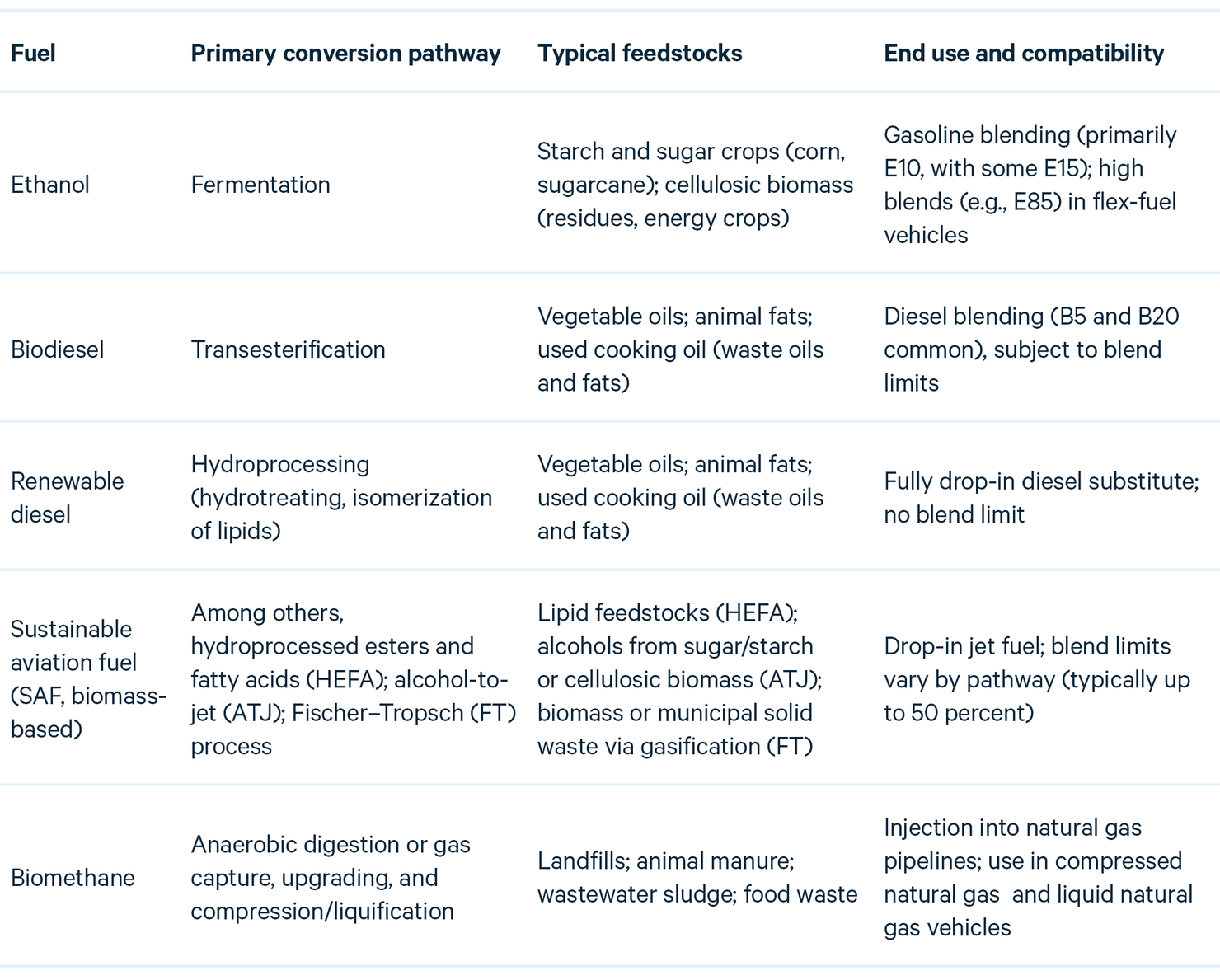
Note: Several biofuels (e.g., biomethanol, bio-liquified natural gas) are being explored for marine shipping but are not yet widely used in the sector.
Class 8 heavy-duty trucks illustrate these constraints. Although full electrification and hydrogen are technologically feasible, they remain costly or operationally challenging (Spiller et al. 2023; Nehrkorn et al. 2024). Renewable diesel, by contrast, can substitute directly for petroleum diesel.
Aviation remains especially constrained, with no commercially viable zero-emission substitutes available at scale in the near term. Efficiency improvements and operational changes can reduce emissions but typically only incrementally, and many of the simpler improvements have already been made. Zero-emission aircraft concepts (battery-electric or hydrogen) remain at an early stage of deployment, and energy-density constraints make long-haul service especially challenging in the near term. As a result, switching to SAFs is seen by the industry as the primary pathway in the near term for meaningful emissions reductions within the sector (Lohawala and Wen 2024).
Marine shipping presents a related set of challenges. The sector remains difficult to decarbonize, and industry and policy discussions increasingly frame fuel choice as central to emissions reductions beyond efficiency improvements. Although biofuel use within this sector remains limited, it could become an important area of future deployment (Kass et al. 2018). Because many vessels already operate on diesel-based fuels, certain renewable fuels could be used without major engine retrofits or capital investment.
In addition to identifying areas where biofuel use may be particularly valuable, panelists discussed barriers to deployment. Even when feedstocks are available and some policy support exists, high fixed costs associated with changing distribution, storage, and handling infrastructure—along with the absence of clear and enduring policy signals—can limit investments in emerging fuel pathways. Notably, the necessary investments in infrastructure differ across fuel types, resulting in different costs of deployment. Section 5 discusses these barriers.
3. Life-Cycle Assessment and Measurement Uncertainty
LCA plays a central role in modern biofuel policies because CI scores often determine eligibility and credit values under federal and state programs. Participants discussed how CI values are constructed and examined major challenges and sources of disagreement in LCA, including land use effects, measurement constraints, and the treatment of climate-smart agriculture. This section focuses on methodologies most commonly used in US biofuel policies. Some areas of debate, such as book-and-claim systems and coproduct accounting, were not discussed in the webinar series and are excluded here. A more extensive discussion of LCA methodology for biofuels can be found in NASEM (2022).
3.1. How LCA Works and Why It Matters
LCA-based CI scores derive from emissions calculated across the full fuel pathway (or life cycle), from feedstock production through processing, transport, and combustion. Direct land use change, the direct conversion of land to energy crops from some other use, is also modeled as part of this step. Total life-cycle emissions are then expressed per unit of energy delivered, yielding a CI score. CI scores are calculated using process-based life-cycle models that track physical inputs and outputs at each stage of fuel production, such as the Greenhouse gases, Regulated Emissions, and Energy use in Technologies (GREET) model. For more details on the GREET model, developed by Argonne National Laboratory, see https://www.anl.gov/topic/greet The use of LCA reflects the fact that many emissions associated with fuels may occur outside the point of use—for example, from feedstock production, transportation, and conversion. As energy supply chains have grown more complex, accounting for upstream emissions has become increasingly important for accurate emissions scoring. In biofuel policy, this logic has supported a shift from simple eligibility thresholds toward assigning fuel-specific CI scores based on LCA, which can support comparisons and choices among fuel options.
Policy design incorporates a second, conceptually distinct and complex component of CI: estimates of how increased demand for biofuel feedstocks alters land use globally, based on insights into the supply and demand for land inputs. These land use effects are estimated using economic equilibrium models. California, for example, relies on the Global Trade Analysis Project (GTAP) model, maintained by Purdue University. For more details on GTAP, see https://www.gtap.agecon.purdue.edu/models/energy/default.asp. These models simulate market-clearing agricultural price and land allocation responses and estimate resulting carbon stock changes based on emissions factors linked to land use and region/ecotype. Although both components are expressed in the same units, they differ fundamentally in nature: one follows biophysical production pathways, using an engineering approach, while the other estimates system-wide responses to a policy shock, using an economic model of resource allocation. Policies conventionally incorporate these values in their design, often by adding the components of life cycle and land use effects together to produce a single CI score that governs eligibility or incentives for different fuels.
3.2. Major Challenges and Sources of Disagreement in LCA
LCA-based emissions estimates can vary depending on the choice of methodology, definitions of system boundaries, and availability and quality of foundational data. Participants discussed challenges in the following six areas: For additional discussion of methodological choices in LCA modeling, see Nematian and Scown (2025).
- Market-mediated effects and ILUC. Traditional process-based LCAs miss system-wide effects that operate through markets when, for example, biofuel production scales sufficiently to affect prices and the allocation of constrained resources, especially land. Attempts to quantify these effects rely on imperfect models and contested parameter choices, contributing to persistent disagreement. This is perhaps the most important challenge in accurately estimating biofuel emissions. See Section 4 for a more in-depth discussion.
- Limited validation and slow-moving data. Elements of LCA modeling have no direct observables in nature, so they cannot be directly validated. Compiling and harmonizing underlying data sets takes time, so models often rely on data that lag current conditions. This raises questions about how well results reflect present or forward-looking realities.
- Temporal dynamics and long-lived carbon fluxes. LCA frameworks are most precise for emissions that occur close in time to fuel production. Considerable uncertainty can arise from emissions and removals that unfold over decades, such as changes in forest biomass and soil carbon stocks. No broadly accepted policy tools currently exist to address this challenge.
- Treatment of emissions determinants where monitoring is costly. Some emissions determinants are measurable in principle, but monitoring can be costly. Disagreement often centers on the trade-off between the desired accuracy and precision of CI and the administrative, reporting, and verification burden imposed on producers.
- Accounting for “waste” materials. In LCA frameworks, the emissions attributed to waste and residue feedstocks depend on assumptions about how those materials would have been produced, managed, used, or disposed of if they were not used in the production of fuel. LCA frameworks commonly assign these feedstocks little or none of the emissions associated with their original production and, in some cases, fuels made from waste materials may receive credits for avoided emissions (e.g., avoided methane emissions from manure decomposition). This treatment can result in very low or even negative CI scores for fuels made from waste feedstocks such as used cooking oil or animal manure. However, there is substantial ambiguity when it comes to identifying waste and defining counterfactual scenarios. For example, policies that credit biofuels created from waste can result in perverse incentives to generate more waste. The treatment of “waste” biofuel feedstocks in LCA frameworks can, therefore, be problematic if it encourages changes in waste production or management practices that increase overall emissions or if it results in the diversion of waste into fuel production from other uses.
- Fossil fuel displacement and rebound. A related debate concerns whether increased biofuel use leads to one-for-one reductions in petroleum consumption or whether some displaced oil is consumed elsewhere as a result of price responses in global fuel markets. As with land use dynamics, displacement and substitution effects require a market analysis of fuel use. This issue often sits outside standard LCA practice but affects the overall greenhouse gas “savings” from biofuel consumption.
3.3. Climate-Smart Agriculture Within Biofuel LCA
On-farm practices such as conservation tillage, cover cropping, and efficient nitrogen may reduce CI while also providing environmental cobenefits, but accounting for their effects requires analysis of intertemporal and highly variable carbon dynamics that define a distinct set of challenges for LCA.
First, LCA models tend not to be well suited for accounting for emissions effects that are determined over multiple decades. Some on-farm practices may increase soil organic carbon accumulation, but there is substantial uncertainty around the durability of carbon stored in soils. Importantly, soil carbon sequestration can be quickly released if management practices change, and current biofuel policies do not have methods of verifying on-farm practice continuation in the short or long term.
Some tools, such as buffer pools (which set aside a share of credited emissions reductions to insure against potential future reversals from unintentional releases) or discounting mechanisms, exist in other policy contexts to manage reversal risk and ensure that incentives are designed appropriately. For example, the Australian Carbon Credit Unit Scheme requires carbon storage from sequestration to be maintained for either a 25- or 100-year permanence period and includes reversal risk management policy design elements. For more information about permanence obligations under the Australian Carbon Credit Unit Scheme, see https://cer.gov.au/schemes/australian-carbon-credit-unit-scheme/how-to-participate-accu-scheme/permanence-obligations.
The question of whether or how to account for temporary soil carbon sequestration within a given policy depends on the specific way a policy is designed and whether it is well suited for appropriately incentivizing activities where the benefits of those activities rely on long-term continuation of practices. Proportional valuation of temporary sequestration, long-term verification of practice continuation, and risk reversal management may be feasible under some policies but infeasible to incorporate into the design or implementation of others. For example, when considering possible changes to 45Z rulemaking, it is valuable to note that the Internal Revenue Service (IRS) lacks mechanisms for verifying the continuation of on-farm practices over many years. Feedstock production occurs upstream of the fuel producer (who claims the tax credit), and the IRS currently has no way to establish an enforcement mechanism that prevents practice reversal, which can release much or all of the accumulated carbon.
Second, panelists discussed challenges related to scientific uncertainty and measurement issues and emphasized the importance of continued investment in research to better understand soil properties, including carbon and nitrogen dynamics. Annual changes in soil carbon are often small relative to existing stocks, making detection and monitoring difficult. These measurement issues limit foundational knowledge of soil carbon dynamics and accounting. Some emissions sources also involve uncertainty related to biophysical production processes or spatial heterogeneity, including nitrous oxide emissions from fertilizer production and variable field-level emissions responses. In these cases, even detailed monitoring may not yield precise estimates of the benefits of certain practices.
Farmers face uncertainty about the effects of conservation practices on their individual fields. For example, the effectiveness of cover crops varies regionally as a result of factors such as different soil and climate conditions. Investments made through farm bill programs can help farmers implement and derisk these practices, but farmers operate in commodity markets with tight margins and may be wary of taking on new risks.
Given the complexities discussed above, a key challenge involves considering whether or how it might be possible, through biofuels policies or other policies, to create systems that provide the public with a high degree of confidence that real effects are being captured while also getting the incentives and compliance requirements right to encourage practice adoption and continuation.
4. Indirect Land Use Change
ILUC remains one of the most debated elements of biofuel policy. Participants discussed the concepts underlying ILUC, the modeling approaches used to estimate it, and the sources of persistent disagreement. They also examined emerging empirical evidence and considered the challenges of incorporating uncertainty into policy design.
4.1. What Is ILUC and Why Does It Matter?
ILUC refers to the market-mediated land use changes associated with increased demand for biofuel feedstocks. Early LCAs focused on emissions from fuel production, inputs, and fuel use. Debate over how to account for broader market effects emerged in the mid-2000s as the United States scaled biofuel production under the RFS.
One participant described the concept of ILUC using the historical expansion of corn ethanol in the United States. When the Energy Independence and Security Act of 2007 expanded the RFS and required a large increase in ethanol volumes, ethanol demand rose, increasing demand for corn and agricultural land. Such demand increases can affect the market in many ways. Land not previously used for farming, such as wetlands, pastures, or forests, may be converted to cropland, and farmers growing other crops may switch crops or sell land in response to changing relative prices. These adjustments can be transmitted through global commodity markets. For example, in this case, higher demand for corn (and land used to grow corn) may have increased competition for land for other crops such as soybeans, potentially contributing to the conversion of existing pastureland to soybean production and the subsequent creation of new pastureland, including in parts of the Amazon.
The issue came to prominence following a study by Searchinger et al. (2008) that examines whether the expansion of US corn ethanol under the RFS contributed to agricultural expansion in other regions of the world. The authors estimate ILUC emissions from US corn ethanol to be large enough to offset its carbon benefits relative to conventional fuels. Some subsequent literature has estimated smaller ILUC emissions (e.g., Hertel et al. 2010, Taheripour et al. 2021). Although the study focuses on corn ethanol, similar market-mediated effects can arise for other crop-based biofuels. Assessing such effects requires models that trace responses through interconnected global agricultural markets, while accounting for productivity trends that may decrease overall demands for cropland.
The same process can occur with forest-based feedstocks. Increased demand for woody biomass could result in land shifting from older, carbon-dense forests to younger, managed forests with faster rotation cycles or marginal agricultural land being converted to forest cover. Even where regrowth occurs, changes in carbon stored in vegetation and soil can result in emissions that would not be captured in process-level accounting and instead must be evaluated through market-mediated modeling.
4.2. How ILUC Is Modeled
Since the late 2000s, most ILUC analysis has relied on economic equilibrium models designed to capture land allocation and market responses. These models may be general equilibrium models representing the full economy or partial equilibrium models focused primarily on agriculture and related sectors. General equilibrium models differ from partial equilibrium models in that they predict responses to increased crop demand across a broader set of sectors, but they rely on stronger behavioral and economic assumptions. However, both model types simulate how markets adjust to increased demand for crop feedstocks and are structured so that supply and demand balance across product and input markets.
Within a model, a policy-driven demand shock is imposed, and the model rebalances supply and demand, producing scenarios of how production shifts across crops. In some regions, higher yields may free up land; in others, agricultural area may expand. Simulated land conversions are translated into emissions impacts by comparing the carbon stocks associated with the affected land types with and without the demand shock. The resulting emissions are divided by the amount of additional fuel associated with the demand shock, producing an ILUC factor expressed in emissions per unit of energy (e.g., grams of carbon dioxide equivalent per megajoule [gCO2e/MJ]).
A suite of modeling approaches has been used to inform biofuel regulations across multiple jurisdictions, including California’s Low Carbon Fuel Standard (LCFS), the US RFS, the EU Renewable Energy Directive (RED), and the International Civil Aviation Organization’s Carbon Offsetting and Reduction Scheme for International Aviation (CORSIA). Some notable models include Purdue University’s GTAP-Bio, the International Institute for Applied Systems Analysis’s Global Biosphere Management Model (GLOBIOM), the USDA’s Forest and Agricultural Sector Optimization Model (FASOM), and the Joint Global Change Research Institute’s Global Change Analysis Model (GCAM) (Joiner et al. 2026).
4.3. Sources of Uncertainty and Disagreement in ILUC Modeling
While there is broad agreement that market-mediated land use responses arise from biofuel production, areas of disagreement center on their magnitude, spatial distribution, timing, and modeling assumptions. These disagreements reflect the inherent difficulty of projecting market-mediated land use change over long time horizons. As one participant noted, even experienced economists struggle to forecast the price of corn six months ahead, yet ILUC models are often asked to project land use responses over much longer time horizons. Small changes in assumptions or parameter values can therefore produce very different results, and this sensitivity is intrinsic to the modeling exercise. Models also differ in spatial resolution, whether and how they model economic responses over time, and how they represent land use change. Moreover, modelers may choose to model demand shocks that differ in size and location. These distinctions can result in meaningful differences in projected ILUC emissions across models.
Participants emphasized that much of the disagreement reflects uncertainty over key parameters such as the price-induced yield effect, which has been debated in the ILUC literature for many years. Limited incentives in academia for empirical work focused on updating and re-estimating key parameters using more recent data—work that often involves replication rather than novelty—may have contributed to the persistent disagreement.
Defining an appropriate counterfactual poses another challenge. It is unrealistic to evaluate a policy by considering a counterfactual that simply assumes absence of the policy while all other conditions remain unchanged. Removing a major source of demand would shift agricultural commodity prices and could prompt government responses, meaning the no-policy world would not remain static. This also points to the inherent inability to validate ex ante model projections using empirical methods. The future with or without the policy remains uncertain.
Finally, large financial interests in CI estimates for biofuels provide incentives to challenge modeling approaches. When analytical results conflict with established commercial interests, they can be harder to accept and disseminate.
4.4. Retrospective Evidence Complementing ILUC Models
A parallel stream of retrospective empirical work on land use change is emerging alongside equilibrium modeling. Several speakers pointed to a recent econometric study by Chen et al. (2025), which uses observed data to estimate how biofuel-driven demand for vegetable oils affected land conversion in Indonesia and Malaysia. Chen et al. (2025) use econometric methods and high-resolution satellite data to examine how global demand for biomass-based diesel between 2002 and 2018 affected forest conversion in Indonesia and Malaysia. They estimate that this demand accounted for roughly one-fifth of forest to oil palm conversion in those two countries during the study period. Their estimates suggest that land use change released more than 1 gigaton of carbon dioxide, implying that over this period, biomass-based diesel generated higher life-cycle carbon emissions per megajoule than fossil diesel. The feasibility of such retrospective work has increased as biofuel policies have operated for nearly two decades and foundational data sets on land use have deepened, creating a longer time series of relevant outcomes. At the same time, causal identification remains difficult because policy and market shocks affect many regions simultaneously, leaving researchers with limited clean “untreated” comparisons. Research design therefore remains central.
A practical advantage of empirical approaches to estimating ILUC is that they do not require the researcher to model every global adjustment margin. However, empirical inputs, including satellite-based land cover data (quite distinct from land use observations), have their own limitations and require careful validation. Some challenges arise when using retrospective analysis to evaluate forward-looking policy scenarios. Evidence from past demand expansions may be informative about the land-use effects of further expanding biofuel demand, but this evidence does not translate mechanically into estimates of what would happen if demand were reduced. Land that has already been cleared or converted may not return to its prior use or carbon stock over policy-relevant time horizons.
Speakers therefore described empirical and modeling approaches as complementary: each carries uncertainty, but analysis using one approach can help refine assumptions and parameters in the other. It is crucial that research using either method is transparent and well documented, as this helps policymakers better interpret results.
4.5. Incorporating ILUC into Policy Design
Treatment of ILUC has emerged as a central source of divergence and controversy in policymaking. Though recent federal changes under 45Z exclude ILUC effects entirely, there is broad consensus that market-mediated land use effects are important to consider and incorporate into policy design. A key challenge results from the uncertainty in ILUC effects; many policies base incentives on a single CI value rather than a range, even though model outputs may have substantial uncertainty.
Jurisdictions have responded to this challenge in different ways. In the United States, state-level LCFS programs (California, Oregon, Washington, and New Mexico) embed ILUC effects directly into CI scoring. Under the RFS, life-cycle GHG emissions are required to consider “direct emissions and indirect emissions such as significant emissions from land use changes.” Unlike LCFS programs and 45Z, in which CI estimates directly affect credit value, RFS uses life-cycle GHG reduction thresholds to categorize fuels. The European Union’s RED does not embed modeled ILUC factors directly into CI scoring and instead manages risk through categorical constraints on higher-risk feedstocks (including placing caps on food-based fuels and phasing out high-risk feedstocks such as palm oil). Similarly, Canada’s Clean Fuel Regulations do not apply ILUC factors into CI scores and instead manage risk through feedstock eligibility rules. More recently, California’s LCFS introduced additional guardrails aimed at reducing land use risks, including making palm-derived fuels ineligible for the credit. See CARB (2024) for more details. New Mexico’s clean transportation fuel standard has also considered limiting or excluding palm oil, given its association with tropical deforestation. See Joiner et al. (2026) for a more detailed discussion of how different jurisdictions incorporate ILUC into policy design.
5. Policy Design and Interactions
In this section, we discuss lessons from two decades of US biofuel policy and the ways in which legislative and regulatory changes may alter market dynamics. We begin with an overview of the current federal and state policy landscape. We then discuss lessons from the past 20 years, including the performance and shortfalls of existing policies; concerns about leakage due to overlapping policies; the economic costs of emissions reductions and the salience of those costs; the design and implementation of CI-based programs; and implications for international trade.
5.1. Federal and State-Level Biofuel Policies
The primary federal policies shaping biofuel markets are the RFS and 45Z. For program details, see Renewable Fuel Standard at https://www.epa.gov/renewable-fuel-standard and Clean Fuel Production Credit at https://www.irs.gov/credits-deductions/clean-fuel-production-credit. The RFS, created in 2005 and later expanded, requires refiners and importers of fossil fuels to blend increasing volumes of renewable fuels. Compliance is demonstrated through renewable identification numbers (RINs). The program includes multiple nested submandates within a hierarchical structure. Through 2022, annual volume obligations were set in statute; EPA now sets future volumes through rulemaking.
The 45Z tax credit, created under the Inflation Reduction Act of 2022, provides a production-based incentive for low-carbon fuels. Credit eligibility and value depend on life-cycle CI, with lower-CI fuels qualifying for larger credits. Initially available for qualifying fuels produced and sold between 2025 and 2027, the credit has now been extended through the end of 2029. Recent amendments excluded ILUC emissions from fuel CI scores, reduced the maximum credit available to SAF producers, and limited eligibility to North American feedstocks.
Biofuel markets are shaped by a growing set of state-level LCFS policies, which create incentives to decarbonize the transportation sector’s fuel supply. California, New Mexico, Oregon, and Washington have adopted LCFS programs. For program details, see the California Low Carbon Fuel Standard at https://ww2.arb.ca.gov/our-work/programs/low-carbon-fuel-standard; New Mexico Clean Transportation Fuel Program at https://www.env.nm.gov/climate-change-bureau/clean-fuel-program/; Oregon Clean Fuels Program at https://www.oregon.gov/deq/ghgp/cfp/pages/cfp-overview.aspx; and Washington Clean Fuel Standard at https://ecology.wa.gov/air-climate/reducing-greenhouse-gas-emissions/clean-fuel-standard. Other states are exploring similar policies. Maryland’s Commission on Climate Change recently advanced a recommendation to study options for increasing low-carbon fuel use, and Vermont has expressed interest. For details, see https://mde.maryland.gov/programs/air/ClimateChange/MCCC/Commission/Final_2025%20MCCC%20Recommendations.pdf and https://legislature.vermont.gov/bill/status/2026/S.171. LCFS programs do not limit eligibility to biofuels; they also incentivize other fuels, such as hydrogen and electrification, though emphasis varies by program. For instance, one participant noted that at the time New Mexico’s clean transportation fuel program was designed, the crediting structure was expected to result in a program that would operate primarily as a biofuel policy in the near term and increasingly as an electrification policy over time. For more details on this program, see NZero (2026).
California’s recent LCFS amendments, which took effect in mid-2025, are a notable development: the CI reduction target increased from 20 to 30 percent by 2030, with steeper increases thereafter. These changes, and their potential impact on gasoline prices in particular, have been controversial. Some economic studies estimate effects as high as about $0.60 per gallon (Cullenward 2024), while the California Air Resources Board has estimated impacts closer to $0.10 per gallon (CARB 2025).
In addition to LCFS programs, several states offer SAF-specific tax credits. As of early 2026, Arkansas, Hawaii, Illinois, Iowa, Minnesota, Nebraska, and Washington have enacted SAF credits (Arkansas’s credit is limited to woody-biomass-derived jet fuel). For details on state-level SAF tax incentives, see Arkansas at https://www.kark.com/news/state-news/new-arkansas-law-creates-incentives-for-alternative-aviation-fuel/; Hawaii at https://www.capitol.hawaii.gov/session/measure_indiv.aspx?billtype=HB&billnumber=1694&year=2026; Illinois at https://tax.illinois.gov/research/taxinformation/sales/aviation-fuel.html; Iowa at https://www.legis.iowa.gov/docs/publications/FTNO/1544058.pdf; Minnesota at https://www.revenue.state.mn.us/sustainable-aviation-fuel-credit; Nebraska at https://ethanol.nebraska.gov/library/press-releases.html/article/2024/04/24/nebraska-gov-jim-pillen-signs-landmark-saf-legislation-into-law; and Washington at https://app.leg.wa.gov/RCW/default.aspx?cite=82.04.4361. Washington is unique in combining a clean fuel standard with a SAF credit; California has proposed a similar SAF credit. For discussion of California’s proposed SAF tax credit, see Smith et al. (2026). https://www.resources.org/common-resources/high-costs-and-few-benefits-from-californias-proposed-sustainable-aviation-fuel-tax-credit/.
5.2. Lessons Learned from the Past 20 Years of Biofuel Policy
5.2.1. How the RFS Performed
The current version of the RFS, established in 2007, was designed around three objectives: energy security, support for agricultural communities, and GHG reduction. The energy security rationale has shifted as the United States became a net oil exporter, reducing the urgency of import-dependence concerns that were salient in the mid-2000s.
The RFS has delivered substantial support to agricultural commodities. One participant cited roughly $24 billion in RIN compliance value in 2023, a scale comparable to major agricultural support programs. Although the distribution of benefits is complex, a large share ultimately accrues to farmers.
The environmental goals of the RFS, however, have not materialized as originally envisioned. The program was expected to drive large increases in cellulosic biofuel production, which did not emerge at commercial scale. Participants argued that this outcome should not be interpreted solely as a technology failure, but also as a failure of policy design to support innovation. Several structural features of the RFS weakened incentives for high-risk technology investment. RIN price volatility and uncertainty about long-term demand reduced the credibility of projected returns, leaving firms to invest based on uncertain future revenues from RIN markets. Blend wall constraints limited the growth of the overall ethanol market, meaning additional cellulosic production risked displacing—rather than expanding beyond—conventional ethanol volumes. Finally, a statutory off-ramp that allows EPA to waive cellulosic mandates when projected volumes are unavailable further weakened expectations of durable demand.
This experience contrasts with the developments in the power sector, where technologies such as wind and solar benefited from more durable and scale-oriented policy support and have experienced significant price declines and scaling as a result. Participants cited examples of early large deployment subsidies (e.g., in Germany and California), renewable portfolio standards that created reliable demand, and industrial policy support—particularly in China—that helped drive cost declines. Comparable long-term deployment and industrial policy support was largely absent for cellulosic biofuels. Panelists emphasized the importance of both designing policies that provide greater certainty and of pairing performance-based standards with durable, reliable support for research and development (R&D).
Experience under the RFS also highlights the need to address infrastructure constraints. Ethanol provides a clear example. The effective corn ethanol mandate under the RFS has long exceeded actual US blending levels, yet the adoption of higher ethanol blends has been slow. Fuel distribution systems—pipelines, terminals, and storage—were designed around conventional gasoline blend stocks and are difficult to reconfigure to handle higher or more variable ethanol blends. Vehicle-side constraints matter too, as some automakers do not provide warranties to certain vehicles if blends above E10 are used. Together, these distribution and warranty frictions present persistent barriers to higher ethanol use despite formal policy support under RFS.
At the time of the webinars, EPA had proposed new RFS volumes for 2026 and 2027. A central issue under discussion was EPA’s proposed plan to reduce RIN generation for domestically produced biofuels made from imported feedstocks and for imported biofuels, relative to fuels made from domestically sourced feedstocks—often referred to as a “half-RIN” approach. The webinars took place while EPA’s 2026–2027 RFS rulemaking was still in progress. EPA finalized the rule on March 27, 2026. In the final rule, EPA did not finalize the proposed import RIN reduction provisions for 2026–2027 but indicated that it may consider such provisions in future rulemakings. For details, see https://www.govinfo.gov/content/pkg/FR-2026-04-01/pdf/2026-06275.pdf. Participants argued that this change, if adopted, could materially affect global fats and oils markets.
Existing policies already make domestically produced soybean oil significantly more valuable in fuel markets than for other uses. Adopting the proposed half-RIN approach would amplify this differential and could drive substantial reshuffling of feedstocks, with non–fuel users shifting supply toward fuel markets and imports filling other uses. It would also reinforce incentives in other federal policies, particularly the 45Z, which, under recent changes, favors North American feedstocks. If implemented alongside these changes, the combined effect would substantially increase the relative advantage of domestic feedstocks, reshaping trade flows and agricultural markets. Participants pointed out that Canada is pursuing similar policy directions, suggesting broader reshuffling of feedstocks across North American markets.
At the same time, by disadvantaging imported fuels, such a policy could also disrupt compliance under California’s LCFS, where imported fuels play an important role in meeting increasingly stringent targets. While renewable diesel volumes in the state may remain high, changes in feedstock sourcing could significantly alter the composition of fuels used for compliance and the total volume of fuel required to meet future targets.
Separately, higher-volume targets could help stabilize a sector that has experienced severe economic stress, with many renewable diesel, biodiesel, and SAF producers currently unprofitable. One participant noted an unusual convergence of interests between agricultural groups and parts of the oil and gas industry in support of higher volume targets; these groups argued that previous mandates were set below actual production capacity.
5.2.2. How California’s LCFS Performed
As mentioned in Section 5.1, unlike the RFS, the LCFS programs establish a declining CI target rather than volume mandates based on discrete GHG thresholds. In contrast to the RFS, this structure creates a continuous incentive for incremental reductions in fuel CI. California’s LCFS has been associated with growth in pathways such as renewable diesel and renewable natural gas from methane digesters. Some participants stressed that the program increased the salience of carbon accounting in fuel markets, encouraging producers and regulators to focus more explicitly on life-cycle emissions. Experience administering pathway-specific CI crediting has informed federal policy discussions, including the design of CI-based incentives such as 45Z.
At the same time, participants noted that the original vision for California’s LCFS was more transformative. In combination with the RFS’s cellulosic component, tightening CI standards were expected to gradually displace crop-based fuels as program targets declined. In practice, however, producers have often responded by making incremental changes, such as process improvements or feedstock adjustments, that lower CI scores while extending the competitiveness of some first-generation biofuels.
It is important to note that state LCFS policies interact with other fuel policies and markets, which can lead to reshuffling of fuels across jurisdictions; these interactions and their effects are central to the evaluation of individual LCFS policies. CI-based policies are also administratively complex to implement. We discuss these issues further in Section 5.2.3.
5.2.3. Cross-Cutting Lessons
Policy Interactions and Leakage
State biofuel policies operate within a dense web of federal mandates, other state programs, and shared fuel markets, making cross-jurisdictional interactions central to understanding real-world impacts. Participants argued that these interactions are often not given enough consideration in state program design.
A key concern is geographic reshuffling rather than additional emissions reductions in response to policy incentives. For many categories of biofuels, the federal RFS is the binding constraint on total national volumes produced, while California’s LCFS primarily influences where fuel is consumed. California’s LCFS may also contribute to shifts in the type of biofuel produced. For example, both biodiesel and renewable diesel rely on lipid feedstocks and are incentivized similarly under the federal RFS. However, California’s LCFS provides a stronger incentive for renewable diesel, which, unlike biodiesel, has no blending limits. Relative to producing biodiesel, producing renewable diesel requires additional processing, which uses energy and generates emissions. Thus, it is unclear whether incentivizing renewable diesel in this way improves or worsens overall GHG outcomes.
Participants discussed whether and how state LCFS programs account for leakage, drawing a contrast with California’s cap-and-trade program, which includes formal leakage considerations. Although policymakers are aware of leakage concerns, addressing them is not always straightforward. An example is California’s treatment of dairy methane, which participants described as an imperfect but deliberate attempt to address one leakage concern. Rather than regulating dairies directly—an approach that raised concerns about producers moving out of state—methane reductions from digesters were credited under the LCFS as transportation fuel. For more details, see Smith (2024).
Economic Cost of Emissions Reductions
Another topic of discussion concerned the cost of emissions reductions under current biofuel policies. One participant cited the example of renewable diesel in California, which receives an estimated subsidy stack of roughly $3.50 per gallon under the LCFS, implying production costs well above those of petroleum diesel. Ongoing research estimates emissions-reduction costs in the range of roughly $400–$500 per ton under existing policies and technologies (Wu et al. 2025). These costs are high relative to the social cost of carbon or mitigation costs observed in the power sector.
Biofuel policies often simultaneously pursue multiple objectives, including agricultural support and rural economic development; as participants noted, this can make cost-effectiveness a less central criterion in policy design. Higher near-term costs may be justified where policy support accelerates innovation or learning-by-doing that lowers costs over time. However, while some improvements have been observed—particularly in ethanol production—there is little evidence that biofuel policy has driven substantial cost declines (Scott 2025). Moreover, the technological breakthroughs once anticipated for advanced biofuels, such as cellulosic fuels, have largely failed to materialize. In some cases, such as for renewable diesel, costs are driven primarily by feedstock prices rather than process efficiency, which limits the scope for innovation to substantially reduce production costs.
Different policy instruments vary in how visibly they surface costs. Under the RFS and LCFS, rising RIN and credit prices make compliance costs salient, triggering concern about gasoline prices and compliance burdens for obligated firms. In contrast, subsidies delivered through tax credits are less visible in market prices and may therefore be less politically salient.
Carbon-Intensity Scoring, Uncertainty, and Divergence Across Jurisdictions
For much of the past two decades, major federal biofuel incentives did not vary with individual pathway CI; under the RFS, a gallon of renewable diesel generates the same RIN value regardless of feedstock or life-cycle emissions. Earlier blender tax credits similarly provided fixed per-gallon support without CI differentiation. The federal approach has shifted with 45Z, which ties credit value to modeled life-cycle emissions using a primarily GREET-based framework, creating pathway-specific incentives. In contrast, state programs like California’s LCFS have long relied on CI scoring.
CI-based policies have an attractive feature: assigning pathway-specific CI values can direct incentives toward fuels with lower modeled emissions. However, this approach raises the stakes of modeling assumptions and parameter choices. If CI estimates are inaccurate or incomplete, incentives may shift resources toward pathways that appear favorable in the accounting framework but deliver smaller real-world emissions reductions. As discussed in Section 3, substantial uncertainty surrounds CI estimates. Because jurisdictions use different models and assumptions, the same fuel can also receive different CI values across programs.
Participants highlighted a recurring challenge facing CI-based policies: policymakers want CI point estimates even when underlying CI estimates are highly uncertain. Regulators generally cannot operationalize CI uncertainty ranges, and uncertainty analyses (including Monte Carlo outputs) rarely translate into crediting rules. Instead, uncertainty is sometimes managed through policy design choices, including conservative point estimates and guardrails such as caps on the use of certain feedstocks and categorical eligibility restrictions (Martin 2026). Several speakers mentioned ongoing debate over alternative ways to treat ILUC and other highly uncertain CI components. They emphasized that CI systems should be able to recognize measurable emissions improvements without being dominated by highly uncertain elements such as ILUC modeling.
Furthermore, incentives can create economy-wide distortions when they target specific end uses and jurisdictions. For example, crediting RNG under transportation fuel policies such as California’s LCFS can shift its use away from other applications, such as electricity generation or on-farm use. Moreover, incentives focused on transportation fuels can shift how feedstocks, including materials treated as waste, are allocated across sectors and regions in a way that may not align with broader climate objectives.
Given the inherent uncertainty of CI-based approaches, some participants stressed the importance and challenge of designing policy with asymmetric risks, such as clearing forested land that will be difficult to revert, in mind to avoid situations where biofuel policies increase net emissions. Participants described risk-based approaches, such as the one used in Canada (see Section 4.5), as potentially useful but also noted their limits. Such approaches still require analytical input to identify and compare feedstock risks, and excluding specific high-risk feedstocks alone does not address broader land use pressures if overall demand for crop-based fuels continues to grow. Framing policy in terms of low-risk versus high-risk feedstocks can encourage overuse of resources deemed acceptable. Even feedstocks considered to be lower risk can create problems if used at a large scale, underscoring the need to consider how much of any resource it makes sense to use.
Implementation Challenges in CI-Based Fuel Policies
Implementing CI-based policies such as California’s LCFS entails several challenges. These programs manage thousands of certified pathways, requiring detailed validation of production processes and CI values. While large biofuel producers account for most credit volumes, many smaller electricity, hydrogen, and niche fuel providers participate as well. This creates a diverse group of actors with a stake in program rules and implementation. States also face numerous consequential implementation decisions during rulemaking that are not fully specified in statute. These include how to credit electricity, hydrogen, and other nonbiofuel pathways alongside liquid biofuels.
Participants noted the tension between scientific precision in CI accounting and practical policy implementation. Pathway-specific CI calculation can become extremely detailed and administratively burdensome, particularly for programs that are already highly complex. Ignoring meaningful differences in emissions performance, however, risks weakening environmental effectiveness. An example where differences may be valuable to estimate involves the addition of carbon capture to the corn ethanol fermentation process. Because the fermentation stream is relatively concentrated in carbon dioxide, capture may cost less than many other CCS applications, making this a potentially cost-effective emissions-reduction option where sequestration is feasible.
Speakers described the implementation challenge as “threading the needle”: designing CI-based systems that are detailed enough to reward real emissions improvements but simple and stable enough to be administrable in practice. One suggested approach was to be deliberate about where and how analysis is used, keeping day-to-day CI calculations simple, while using more detailed analysis in periodic reviews and regulatory impact assessments to assess performance and guide adjustments.
Effects on International Trade
Because biofuel policies operate within integrated global agricultural markets, they can affect international trade in multiple ways. For example, California’s LCFS increased imports of renewable diesel, particularly before US refining capacity expanded. Similarly, higher credit values for waste-based feedstocks have contributed to large imports of used cooking oil, mostly from Asia (particularly China).
Recent federal policy changes tie 45Z eligibility to feedstock origin, restricting credits to feedstocks sourced in North America. However, because vegetable oils are highly substitutable across food and fuel markets, such eligibility restrictions may shift trade patterns rather than eliminate demand. Diverting more domestic soybean oil into biofuels can increase imports of other oils, such as palm oil, for food use, reallocating production and trade across sectors and countries.
6. Areas for Future Research
Participants identified several domains where additional research could sharpen understanding of biofuels’ long-run role and inform policy design. This section outlines these areas and describes the challenges that shape what can be learned.
6.1. Innovation, Scale-Up, and Policy Credibility
Experience with cellulosic biofuels raises a question: Under what conditions do new fuel technologies move from lab studies to pilots to demonstrations to sustained commercial scale? As discussed in Section 5.2.1, participants argued that the limited commercial scale-up of cellulosic fuels reflected in part the limitations in policy design. The central questions are how policy tools can support early commercial deployment and how they should vary across stages of technological development.
Participants discussed pairing performance- or pathway-based standards, including LCFS-style programs, with more durable R&D support for pilots and demonstrations. Fuel crediting programs such as LCFS-style standards are technology-neutral and allow multiple current and future pathways to compete on cost rather than presuming which technologies will succeed, but technology-neutral policies may not be well suited to address early-stage technical barriers, where more targeted help is needed.
When technologies are technically viable but face high first-of-a-kind and scale-up costs, policies that can derisk such investments are needed to make them more attractive to private capital markets. A broad range of policies can do this in theory, applied by governments or in some cases the private sector, including advanced market commitments, prizes, contracts for differences, and tax credits. Such options may better address first-of-a-kind barriers than relying on volatile credit markets or uncertain long-term credit prices, though trade-offs among these policies exist (e.g., cost efficiency and government spending).
6.2. Policy Design, Interactions, and Additionality
Domestic biofuel policy operates through multiple overlapping federal and state programs. As discussed in Section 5.2.3, this creates a risk that policies primarily reshuffle fuels across jurisdictions or pathways rather than expand the supply of low-carbon fuels. The central question is whether existing policies can be designed to induce emissions-reducing actions that would not occur otherwise. Answering this question requires linking specific policy changes to resulting shifts in production volumes, fuel pathways, and technology adoption, while tracking cross-market flows, to determine whether observed changes reflect increases in total production or reallocation of existing fuels. Wu et al. (2025), for example, have developed a model of on-road and aviation fuel markets and US policy interactions to examine how potential policy changes could affect outcomes in California and the rest of the United States.
The political economy of biofuel policy interactions was also mentioned as an important research area. For instance, have state policies such as California’s LCFS influenced the evolution or expansion of federal policies such as the RFS?
A separate question concerns the scope of LCFS-style programs. Participants asked whether CI-based standards could provide a state-level pathway for advancing transportation electrification in contexts where vehicle mandates face legal or political constraints. Understanding how different approaches to crediting electricity interact with existing regulations and affect economic outcomes is also necessary.
6.3. Cross-Sector Allocation and Long-Run Transition Strategy
Several participants stressed the need to think comprehensively about how limited biofuel resources are allocated across end uses. The supply of sustainable biomass is constrained, and biofuels may offer different emissions reduction opportunities across sectors. Policy and research therefore should assess where biofuels provide the greatest value per dollar of public support. The contrast between renewable diesel and SAF based on hydroprocessed esters and fatty acids illustrates this issue. Both rely on similar lipid feedstocks, and existing incentives have supported substantial renewable diesel scale-up, while SAF volumes remain limited, even though aviation is widely seen as having fewer near-term in-sector mitigation options than many surface transport segments.
Participants emphasized that assessing how biofuels should be allocated across sectors requires accounting for how mitigation options may evolve over time, including uncertainty in future technology costs, policy constraints, and the relative availability of alternatives. For example, whether lipid feedstocks provide greater value in road transport or aviation depends on how competing options evolve. Electrification may expand in some surface transport segments, though the pace and extent remain uncertain. In aviation, outcomes depend on the costs of alternative SAF pathways and of carbon removal paired with continued fossil fuel use.
Beyond comparisons of current end uses and long-run allocation outcomes, participants noted that uncertainty also lies in how transitions unfold in practice, including their timing, sequencing, and intermediate impacts. Aviation illustrates this point because innovation and scaling dynamics in these fuel markets have differed from those in on-road fuel markets. Some developers who struggled to scale technologies in surface transport pivoted toward aviation, where demand conditions, institutional priorities, and policy signals were more conducive to uptake. This suggests that where new fuel technologies scale first is shaped by demand, investment conditions, and policy design. Understanding these dynamics matters for assessing how biofuels are allocated across sectors over time, not just where they end up eventually.
Long-run technological uncertainty is an important consideration for policy design. One participant illustrated this point using synthetic power-to-liquid (PtL) fuels, which require low-cost clean electricity to produce green hydrogen. Promoting PtL SAF today could accelerate learning and cost reductions, but it would require committing resources while key inputs remain constrained and costs are still high, rather than waiting to scale deployment once those constraints ease.
In this context, participants underscored the importance of policy designs that allow lower-cost emissions reductions to emerge over time. Ex ante, it is unclear which aviation mitigation pathway will ultimately prove least costly. Alternatives such as conventional jet fuel paired with carbon removal may compete with SAF. Policies that avoid preselecting technologies but rather focus on incentives for carbon mitigation can allow cost-effective options to emerge in the long run.
6.4. How Biofuel Policies Shape the Agricultural System
Participants emphasized that understanding the impacts of biofuel policies requires understanding their impacts on agriculture, both domestic and global. Domestically, what do we want the US agricultural system to look like under sustained biofuel demand? What is the crop mix and scale of this system (e.g., how much acreage should be devoted to corn), and how should the trade-offs that these choices imply be considered? These trade-offs involve both economic and environmental considerations, including effects on farm income, farm policy, water quality, and other ecosystem services.
At the same time, domestic biofuel policies affect agricultural systems beyond national borders. Redirecting US agricultural productivity toward domestic energy uses can reduce agricultural exports and shift production abroad. Because agricultural expansion at the global frontier is associated with high climate costs, these spillovers remain a source of concern. The broader questions are how biofuel policies will reshape the agricultural system, both domestically and globally, and how competing economic and environmental trade-offs should be evaluated.
Participants stressed that it is essential to think about feedstocks in a global context. Feedstock demand and competition—both from biofuels and from the agriculture system more broadly—can create or worsen hot spots, areas where land conversion and deforestation would be particularly environmentally harmful. Understanding what the US biofuel market and the feedstock base of that market would look like if these regions were sufficiently protected is necessary to design policies that include appropriate guardrails against adverse outcomes and create incentives for technological innovation, development, and deployment of biofuels that pose lower environmental risks.
6.5. LCA and ILUC
Several participants noted that land use remains a highly uncertain and policy-relevant channel through which biofuels affect climate outcomes and indicated the growing scope for retrospective empirical work to complement model-based ILUC assessment (see Section 4.3). Nevertheless, equilibrium models remain central in practice and rely on parameters estimated from data.
Disagreements across ILUC estimates can often be traced to differences in inputs such as parameter values, data sets, and implementation choices. For policy purposes, therefore, a particularly useful role of econometrics lies in estimating specific relationships that directly inform land use modeling, such as yield responses to commodity price changes, relationships between commodity demand and land outcomes, and price transmission across crops and regions. Participants also emphasized the importance of continuing to reestimate and update key parameters using newer data that reflect changing markets and technologies. Econometric analysis with sufficient analytical power is crucial, given how heavily these parameters influence ILUC projections and how long some have remained contested.
Participants also highlighted the need for transparency and documentation. When model results change across updates, stakeholders should be provided an accessible explanation for what changed—assumptions, parameters, data sources, or implementation. EPA (2023) provides a useful example of comparing outputs across frameworks to clarify why results differ and to support interpretation.
Participants called attention to several land system margins where improved evidence and model representation could materially affect ILUC and life-cycle estimates. One area for further research is the geographic scope of market adjustment: To what extent do demand shocks propagate through globally connected commodity markets? Empirical work, such as research on price transmission across related commodity markets (e.g., vegetable oils) and across regions, could help narrow disagreement on ILUC.
Forest dynamics are an area where common modeling assumptions may be too stylized. Participants argued that in settings such as Brazil, cropland expansion may occur not only through direct clearing of intact forest but also by occupying land that would otherwise have reverted to forest over time. Because the carbon implications of forgone regrowth differ from those of clearing mature forest, more dynamic treatment of forest carbon stocks and fluxes is needed, rather than relying on a static forest conversion emissions factor.
Relatedly, livestock and pasture dynamics are central to land use change in regions such as Brazil, where deforestation often occurs first through pasture expansion. Changes in livestock production systems, including movement toward feedlots, may affect pasture demand and subsequent cropland expansion, but these pathways remain underrepresented in many ILUC frameworks.
Another area of discussion was how better measurement and empirical observation can inform both life-cycle accounting and land system modeling. One example is the use of satellite data to measure how much crop residue remains on fields after harvest. Changes in residue cover can indicate shifts in tillage and residue management, which matter for fertilizer use, soil carbon outcomes, and the availability of residues for energy production.
Participants also discussed the importance of technological advances in identifying, measuring, and modeling field-level changes in emissions (e.g., of nitrogen or soil carbon), including in situ sampling, and suggested that improving reliability and reducing cost could improve the credibility and practicality of incentives tied to agricultural practices by better linking crediting to observed outcomes.
6.6. Opportunities for Interdisciplinary Research
Participants identified several areas where interdisciplinary research could be particularly valuable. One area involves closer integration of climate, water quality, and agricultural research. For example, some biofuel policies could affect soil and water quality outcomes, yet research on these effects often occurs in separate scientific communities. Moreover, stronger links between land use modeling and empirical land use research are needed. Current models used to estimate ILUC often rely on stylized representations of land systems, which may not fully reflect observed land use dynamics. Interdisciplinary research could help improve the empirical grounding of these models. Bringing together researchers working in different disciplines and with different methodological approaches could improve understanding of the broader environmental implications of biofuel incentives and help inform future policy design.