Lowering the Carbon Intensity of Ethanol-to-Jet Aviation Fuel
This brief evaluates whether carbon intensity reductions for corn-based ethanol-to-jet aviation fuel are achievable without substantially increasing costs amid high abatement expenses and policy uncertainty.
Sustainable aviation fuels (SAFs) are widely viewed as essential in the near-to-medium term for significantly reducing greenhouse gas (GHG) emissions in the aviation sector. The International Civil Aviation Organization (ICAO) has set a goal of net-zero aviation emissions by 2050, and several jurisdictions—including the European Union and United Kingdom—have adopted policies mandating increasing SAF use. The United States has several tax breaks available to SAF producers. See Lohawala et al. (2026) for an overview of SAF policy frameworks in the United States and other jurisdictions. Despite these policy signals, however, SAF production remains far below the scale required to meet ICAO’s longer-term emission-mitigation targets (ICAO 2025a).
Several technological pathways exist for producing SAF. One emerging option is ethanol-to-jet (ETJ), which converts ethanol derived from biomass into jet fuel through a series of chemical processes. Because ethanol production is already well established—particularly in the United States—ETJ has attracted attention as a pathway that could expand SAF supply in the near-to-medium term. Companies such as LanzaJet (which began operating the first commercial-scale US ETJ facility in 2024), Gevo, and Summit Next Gen are pursuing ETJ.
Lohawala (2026) examined the potential role of corn-based, or “first-generation,” ETJ in SAF markets by comparing it with the hydroprocessed esters and fatty acids (HEFA) pathway—the most established SAF technology today—which converts lipid feedstocks, such as vegetable oils and animal fats, into jet fuel. That analysis identified several factors that have drawn interest to ETJ relative to HEFA. First, lipid feedstocks are limited and already face competing demand from renewable diesel and other markets, raising concerns about long-term availability. By contrast, US corn-based ethanol production occurs at large scale, supported by extensive agricultural supply chains and processing infrastructure, creating the possibility of expanding SAF production by leveraging an established industry. Such expansion may also become more relevant for ethanol producers if demand for ethanol in road transportation declines as electric vehicles gain market share. The analysis also noted that ETJ may be more cost-competitive, in part because corn feedstocks are typically less expensive than vegetable oils.
However, the analysis highlighted an important challenge: the life-cycle carbon intensity (CI) of corn-based ETJ. CI is a central metric in SAF policy because many programs worldwide condition eligibility or credit values on the estimated CI of a fuel relative to fossil jet fuel. The CI for corn-based fuels can be substantial, reflecting emissions from fertilizer use, farm energy, ethanol processing, and potential land-use change in crop production. The potential role of corn-based ETJ as a low-carbon aviation fuel depends on the extent to which its CI can be reduced without sharply increasing production costs.
We examine how this CI-reduction challenge could be addressed by focusing on emissions-reduction strategies that the literature identifies as having relatively large mitigation potential across the ETJ supply chain. Although these strategies can lower emissions, they also introduce additional costs and infrastructure requirements that create barriers for scaling up ETJ.
1. Approach
To explore the trade-offs, we draw on a study by researchers at the National Renewable Energy Laboratory and Argonne National Laboratory (Uddin et al. 2025; the “Lab Study”). The study provides estimates of carbon-reduction potential and incremental cost of several strategies in producing corn-based ETJ. We extend this analysis by incorporating additional cost components and examining practical constraints on deploying the strategies on a larger scale.
The study uses the 2024 Research and Development (R&D) version of Argonne’s Greenhouse Gases, Regulated Emissions, and Energy Use in Technologies (GREET) model developed to estimate life-cycle CI. We focus on strategies that the Lab Study finds to be among the more effective at reducing the CI of first-generation ETJ production. The Lab Study also analyzes “second-generation” ETJ, in which corn stover as well as grain are converted to ethanol. These include growing cover crops to increase soil carbon, using lower-carbon energy sources in the ethanol plant, and preventing carbon dioxide (CO2) produced during ethanol fermentation from escaping to the atmosphere.
We draw on the Lab Study to present several metrics for the CI-reduction strategies considered for corn-based ETJ. First, we report the estimated CI reductions associated with each strategy. Second, we report the corresponding “minimum feasible sale price” needed to fully recoup costs—this is a bottom-up estimate of the cost of producing the fuel, computed using discounted cash flow analysis in the techno-economic assessment; it does not account for policy incentives or downstream costs included in the final sales price. Relative to the Lab Study, our estimates incorporate some additional relevant cost components. Third, we present estimates of the marginal costs of reducing emissions for the options considered, relative to fossil jet fuel. Finally, we discuss key implementation challenges and uncertainties in the estimates and the implications for ETJ’s role in reducing aviation emissions.
Life-cycle emissions assessments and techno-economic assessments can vary due to differences in underlying assumptions. Nevertheless, the estimates from the Lab Study provide a good illustration of both possibilities and challenges related to reducing the CI of corn ETJ.
To interpret the findings from the Lab Study, we first note a few baseline values. Based on the 2024 R&D GREET model, the study uses a CI of 69.1 grams of carbon dioxide equivalent per megajoule (gCO2e/MJ) for first-generation corn-based ETJ production without additional mitigation measures; 9.0 gCO2e/MJ is attributed to indirect land-use change. This estimate is ~22 percent lower than that of fossil jet fuel (89 gCO2e/MJ).
Estimates of baseline CI vary with modeling choices. The estimate in the Lab Study is lower than the CI used in the Carbon Offsetting and Reduction Scheme for International Aviation (CORSIA) for US-based corn ETJ, which is 90.8 gCO2e/MJ (see ICAO 2025b). The CORSIA estimate includes much higher emissions from indirect land-use change (Table 1). However, the difference in baseline CI does not affect the absolute magnitude of the CI reductions with additional measures presented later.
Table 1. Differing Carbon-Intensity Estimates for First-Generation Corn-Based Ethanol-to-Jet Fuel

Sources: ICAO (2025b); Uddin et al. (2025). All figures are in gCO2e/MJ.
The Lab Study calculates a minimum cost-recovery sale price of $3.00 per gallon of gasoline equivalent (GGE) in 2023 dollars for baseline corn-based ETJ. This is the reference value used to evaluate increases in the minimum feasible sale price with added measures to reduce CI. The 2025 wholesale price of Jet A (also in 2023 dollars) averaged ~$1.79, ~40 percent lower than the minimum cost-recovery price for baseline ETJ.
2. Reducing Emissions from Feedstock Cultivation
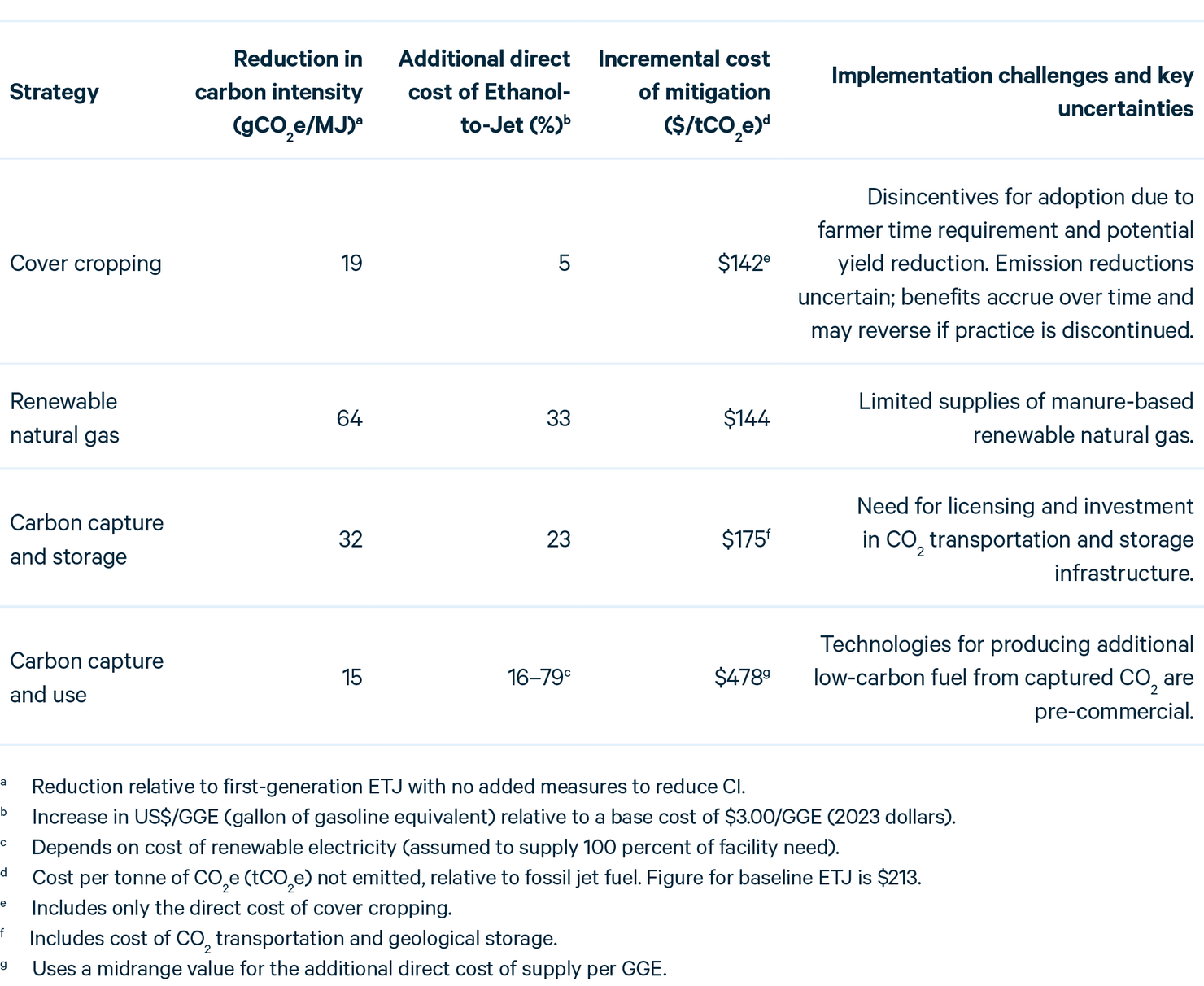
One option involves adopting agricultural practices that increase soil carbon storage, which also can increase agricultural productivity. The Lab Study indicates that cover cropping can reduce the CI of corn-based ETJ by roughly 19 gCO2e/MJ (Table 2). This reflects increased soil carbon when the cover crop is plowed under. The Lab Study assesses that cover cropping raises the minimum necessary sales price by $0.15/GGE, which is 5 percent of the baseline value. However, it also competes with other uses of the farmer’s time and can reduce cash crop yields (Sawadgo and Plastina 2022). These factors raise the opportunity cost of cover cropping and act as disincentives to adoption.
The mitigation benefits from increased soil carbon only accrue over time. In addition, soil carbon gains are not necessarily permanent: if farmers discontinue these practices, soil carbon can decline (Nematian and Scown 2025). As a result, the long-term emissions reductions attributable to cover cropping remain uncertain.
Table 2. Impacts of Different Strategies for Reducing Carbon-Intensity Estimates for First-Generation Corn-Based Ethanol-to-Jet Fuel
3. Replacing Fossil Natural Gas with Renewable Natural Gas in Processing Plant Energy
Another option is replacing fossil natural gas in the processing plant with renewable natural gas from animal manure. The Lab Study estimates that this can reduce the CI of corn-based ETJ by roughly 64 gCO2e/MJ, reflecting avoided methane emissions that would occur during anaerobic manure decomposition and that methane is a much more potent GHG than CO2. However, renewable natural gas is costly, as the study points out. Moreover, its supply is limited by the amount of manure that can be effectively collected and put into digesters. The Lab Study assesses that this substitution would increase the minimum necessary sales price by one third relative to the baseline value (almost $1.00/GGE).
4. Adding Carbon Capture and Storage (CCS) to Ethanol Fermentation
The Lab Study estimates that capturing the CO2 stream produced during ethanol fermentation and transporting it to ultra-long-term geological storage facilities could reduce the life-cycle CI of ethanol production by roughly 32 gCO2e/MJ. Because this CO2 is “biogenic”—offset by the CO2 uptake from feedstock growth—preventing its release to the atmosphere results in “negative emissions.” The CO2 stream also is relatively pure and highly concentrated compared with many industrial sources, which lowers capture cost.
The Lab Study estimates that the increase in price needed to recover the cost of purifying and compressing the captured CO2 would be ~$0.04/GGE. However, this excludes the cost of pipeline transport and geological storage.
To illustrate the potential magnitude of these additional costs, we provide a back-of-the-envelope estimate of the levelized cost of transporting CO2 for 500 miles by pipeline. (This cost converts upfront capital investment into an annualized value and adds recurring operating expenses to obtain a cost per tonne of CO2.) We start with an ethanol plant producing 100 million gallons per year, which is roughly the average across most US plants (EIA 2025). Such a plant generates approximately 300,000 tonnes of CO2 annually from fermentation.
Based on default assumptions in the National Energy Technology Laboratory’s CO2 Transport Cost Model (Morgan et al. 2024), we assume an 8-inch-diameter pipeline, unit capital cost of $54,400 per inch-mile, and 20-year project life; we also assume a 10 percent discount rate. Annual fixed operation and maintenance costs are assumed to be 2.5 percent of the initial capital investment for the pipeline and 4.0 percent for the booster pumps, with a variable expense of $2.04 per tonne CO2. Under these assumptions, our estimate is $134 per tonne of CO2 (in 2023 dollars). To illustrate the sensitivity of this figure to assumptions, the cost is ~$101 if the capital cost is one third lower or ~$146 if the discount rate is 12 percent.
Finally, we assume a geological storage cost of ~$13 per tonne by averaging figures from sources presented in Rubin et al. (2015, Table 13). This yields a combined transport and storage cost of ~$147 per tonne CO2, or $0.44 per gallon of ethanol. Given that a GGE of ETJ requires ~1.5 gallons of ethanol, the cost increase per GGE of ETJ to cover CO2 transport and storage costs with CCS is ~$0.66. Adding to this the $0.04/GGE cost of purifying and compressing the captured emissions yields a total cost of ~$0.70/GGE, ~23 percent more than the baseline value.
Although this estimate depends on specific assumptions, it suggests that the costs for pipeline transport and storage capacity are substantially higher than for purification and compression. These would likely be even higher for smaller-scale infrastructure with fewer economies of scale. This creates an incentive to locate large-scale ethanol facilities near CO2 pipelines and geological storage facilities (Gevo is pursuing this approach). However, doing so could require transporting feedstocks over longer distances, which would increase both CI and production cost.
For example, based on an online calculator from the American Coalition for Ethanol (n.d.), transporting corn an additional 100 miles would increase the CI of ethanol by ~2.1 gCO2e/MJ. Using grain truck rates from the US Department of Agriculture (2025, Table 4), with a truck capacity of 55,000 pounds, 56 pounds per bushel of corn, and 2.8 gallons of ethanol per bushel, we estimate that shipping the feedstock 100 miles would raise ethanol costs by roughly $0.15–$0.19 per gallon, or ~$0.22–$0.28 per GGE of ETJ (all in 2023 dollars).
Access to shared transport infrastructure could reduce these costs. For example, Summit Carbon Solutions has proposed a multistate CO2 pipeline network designed to collect emissions from ethanol plants across the Midwest and transport them to geological storage sites. If such networks materialize, they could reduce unit costs by aggregating emissions across multiple facilities and enabling shared trunk-line infrastructure.
5. Adding Carbon Capture and Use (CCU) to Ethanol Fermentation
Another option is using the high-quality captured CO2 emissions to produce additional fuel rather than storing it. The Lab Study evaluated the implications of adding facilities for producing green hydrogen and combining it with the CO2 to produce ethanol through “gas fermentation.” A version of this technology was developed by Lanza Tech and is being used in LanzaJet’s commercial facility. The process is energy intensive; the study assumed the facility was powered entirely by renewable (zero-carbon) electricity.
The Lab Study assessed the CI reduction from the combined ethanol output as ~15 gCO2/MJ—less than with CCS. This would be considerably smaller if the electricity were not fully renewable. The increase in the price per GGE needed to recover costs is $0.49–$2.38, or 16–79 percent of the baseline value, depending on the cost of renewable electricity. The study noted that this could be $0.02–$0.10 per kilowatt-hour. Further cost reductions depend on considerable technical advances in gas fermentation (De Luna et al, 2019).
6. Marginal Cost of Emission Reductions from ETJ
Table 2 also shows the marginal cost of emissions reductions from ETJ relative to fossil jet fuel under different CI reduction options. This metric indicates how much it costs to avoid one tonne of CO2e by using ETJ instead of conventional fuel. It is calculated by dividing the incremental cost of producing ETJ under different strategies (relative to the price of fossil jet fuel) by the reduction in life-cycle CI. The estimates shown (in 2023 dollars) assume a fossil jet fuel price of $2.50. With an average 2025 fossil jet price of $1.79, as noted above, the marginal cost estimates would be higher.
Across the options discussed, estimated marginal costs are $142–$478 per tCO2e. The relatively low estimated marginal cost of $142/tCO2e for cover cropping reflects a combination of assumptions. First, it includes only direct implementation costs and excludes other potential opportunity costs. Second, it assumes the permanence of the emissions reductions attributed to cover cropping. As discussed above, however, the durability of those emissions reductions remains uncertain. For comparison, baseline ETJ without additional mitigation measures has a marginal cost of $213 per tCO2e. The Lab Study does not report a comprehensive figure for the marginal cost with CCS applied to the ethanol fermentation. However, applying its methodology with our back-of-the-envelope calculation of CO2 transport (500 miles) and storage costs yields a marginal cost of $175 per tCO2e.
7. Looking Forward
All the options considered for further reducing the CI of corn-based ETJ fuel add to its cost, in some cases considerably. Moreover, the marginal costs per unit of avoided emissions are above marginal costs of mitigation in other sectors—as revealed, for example, by allowance prices in the EU emissions trading system. Some are larger than a measure of the benefit to society of reducing emissions frequently cited in the economics literature—the “social cost of carbon,” which recent studies place at ~$185/t CO2e (Rennert et al. 2022). This is entirely consistent with aviation being a hard-to-abate sector given current technologies. However, reducing or offsetting its net emissions is unavoidable if the goal is to achieve net-zero economic activity.
Policy support materially affects the economics of implementing CI-reduction measures for corn-based ETJ; however, jurisdictions differ substantially in how they treat corn-based ETJ. In the United States, relevant incentives include the Section 45Z clean fuel tax credit (based on measured CI), 45Q credit for CCS and CCU, 45V clean hydrogen production credit (which affects the cost of a critical CCU input), and state-level low-carbon fuel standards, where eligible ETJ pathways can generate credits. The tax credits are set to expire in less than a decade. US ETJ producers also could benefit from the US Renewable Fuel Standard if the pathway becomes eligible under this program. An ETJ facility cannot combine 45Z with 45Q or 45V in the same tax year. Nonetheless, using CCS or low-carbon hydrogen drives down the CI score and increases the 45Z credit. In contrast, the EU SAF mandate under the ReFuelEU program excludes corn-based ETJ, because food- and feed-based fuels do not qualify. That limits the opportunity for US producers of corn-based ETJ to expand into foreign markets (Lohawala, 2026).
Policies that tie support to life-cycle CI—such as Section 45Z or low-carbon fuel standards that decline over time—create ongoing incentives for CI reduction. However, the estimated life-cycle CI depends on carbon accounting choices that vary across jurisdictions. As noted earlier, one important source of uncertainty is indirect land-use change, which in part explains differences in how jurisdictions such as the United States and the European Union treat corn-based ETJ.
Among the CI reduction measures examined, a significant source of uncertainty concerns the emissions reductions from cover cropping. This reflects a range of challenges, from measurement difficulties to the treatment of emissions processes that unfold over long time horizons. Measurement challenges are discussed in Joiner and Toman (2023). The durability and quantity of soil carbon gains from practices like cover cropping are difficult to fully resolve, and benefits depend on long-term continuation of practices. Research in measurement, modeling, and verification of emission changes can help reduce some of these uncertainties. However, risks related to mismeasurement and reversal may remain. As a result, policy design must contend with the risk of over- or under-crediting emissions reductions from different practices, which affects both the environmental integrity of policy incentives and the competitiveness of ETJ under CI-based frameworks.
The feasibility of CI reduction also depends on enabling infrastructure. Expanding access to CO2 transport and storage could materially lower the cost of CCS, improving the competitiveness of ETJ under CI-based policies. This in turn requires advances in permitting for CO2 transport and storage investments and policies governing pricing for these services (Boyd et al. 2024).
It is reasonable to expect technological innovation to lower the costs of low-carbon SAF production, including ETJ, through advances in biochemical and electrochemical processes and learning from experience. The government has a clear role in funding more basic research and ameliorating the financial risks of scaling up pioneer technologies. Ultimately, however, it remains uncertain how far current or future technological improvements in corn-based ETJ will reduce CI, and how the pathway will compare with alternatives in terms of cost of reducing aviation’s carbon footprint.
Given this uncertainty, policies that increase options by encouraging innovation across multiple pathways—an approach often described as “technology neutrality”—can play an important role in achieving emissions reductions at lower cost. One widely discussed alternative is the power-to-liquid (PtL) pathway, which combines green hydrogen with captured CO2 in a high-energy-intensity industrial process. Although PtL is expensive relative to ETJ, it can achieve very low life-cycle CI when produced using low-carbon electricity and hydrogen along with CO2 captured from the atmosphere. As with ETJ, however, the degree of future cost reduction from technical advance in PtL is uncertain. Without significant further technical progress, net-zero aviation emissions may only be achievable in practice through negative-emission offsets.